

I have to say that I am a big fan of the new Artboy Gallery in Prahran. Being a south-sider, away from the nest of things north of Victoria st, its been great to see several new and existing galleries in the area starting to support more work of an urban and street art derivation. Artboy is certainly one gallery helping to lead the charge in the area, and its range of works and artists is both varied and impressive in the talent stakes.
So, it was with a fair amount of satisfaction that I saw they were holding their first artist show since their opening only a few months ago, featuring one of their many supported artists, Dirtfish.
With a mesh of urban inspired styles, distinctive characters, and gritty, often thematically meshed works, we decided it best, of course, if we got the lowdown from the man himself on his works, the upcoming show, and what creative sparks lie within …

Always the first up standard question – who are you, where are you from, why do you love art, and what exactly is a dirtfish? ;)
My name is Lee and I live and work in Melbourne. I’ve always been drawn to creative pursuits and studied Visual Communication & Design at Monash. I run a graphic design studio called 3sidedsquare.com with some friends in Northcote.
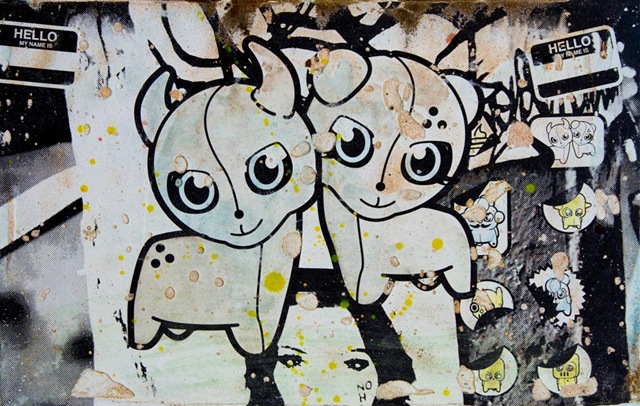
I sign all my paintings with a little stick figure character called dirtfish. The dirtfish symbol also appears in the paintings, sometimes as a logo, sometimes as a building block for the characters.
You’ve been working under the dirtfish name since 2006, how have you found your work has progressed and evolved in the past five years?
I’ve been using the same wet-transfer technique since I started, but I now stretch all my own canvases and the quality and durability of the canvas and stretcher arms I use has increased. The family of characters has grown over the years and each collection tends to have a different mood.
You have a wide range of influences, from street art to comics, stencils to pop art – how have you found your own style amongst these influences, and how have you developed it over time?
I don’t really think I give much thought to defining my style, I just make stuff that appeals to me and that I’m happy to hang on my walls. If the paintings don’t sell, that’s where they end up, so there’s no point doing anything I don’t like.
Your work has a fair amount of characters within it, many of which seem to be represented in various different uses within it – do you have any central motifs with these characters, or storylines behind them, and what do you believe the characters represent, as seen through others eyes?
The first characters in the dirtfish universe were the cloudsellers. Other characters were introduced to provide light and dark (both visually and emotionally).
The new waves of characters tend to share a resemblance – there was a set of fluffy and hairy critters, a bunch of grumpy angry little guys and most recently, a collection of three-legged soft toys. The stories I tell myself about the characters when I’m putting the designs together are often very different to the stories viewers come up with on their own.
When people ask me what a particular painting is about, I ask them what they think it means because it’s much more interesting for me to hear the stories sparked by their imagination.
You have done a bit of graphic and web design in the past few years, how do you find the transition and positioning of your work between the commercial aspect and your artistic side? Are there major divisions, or, do you find themes leaking from one to the other?
Many of the graphic design and web development projects I work on are very straight down the line, but some clients are open to more creative results. Branding projects are always a lot of fun to work on and a chance to flex creative muscles – but my brain is filled with more geeky programming languages and keyboard shortcuts than I care to admit.
You often work from a template that you’ve designed on the computer, to then transferring to a canvas and working in a de-constructive way on the pieces – what do you find most enjoyable about this process, and what other methods do you incorporate into it?
I like the order and precision of designing on the computer, but enjoy the happy accidents that arise when transferring the design to canvas. The canvas is prepared for the transfer with white house paint and a specialty paint containing iron filings that rust. I work over the top of the carbon transfer with water colours and inks. I get into a rhythm when I’m working and get a kick out of seeing the pieces come to life. Each new painting becomes my favourite.

Can you tell us a little about your upcoming show at ArtBoy Gallery, and how you got involved with the gallery there also? The major piece for the show comprises 48 individual canvases – can you tell us something of this? Is it a contiguous piece and do the 48 smaller pieces make up a larger whole, or are they individual, thematically linked works?
I’ve known Marc from ArtBoy for years, because of his involvement with other commercial galleries. When I found out he was coming back to Melbourne to open a new gallery, I was really excited to get involved. We worked on the ArtBoy logo and branding together, and I have several pieces on permanent display in the gallery.
The 48-piece “hello my name is” is a set of separate paintings inspired by street graffiti from different cities around the world. Each canvas was designed to work as a stand-alone piece, but I like the sense of scale provided by hanging them in a grid. I find it exciting to think that I’ll probably only have one chance to see the paintings hung together before they all go off to different homes.

I saw mentioned on your website that you’ve also dabbled in some custom toys – this feels like a logical extension, having seen your work – what do you believe the place of toys is in the urban art scene, what do they mean for you, and who else do you believe is producing some cool work we can check out?
I’ve collected a lot of Qees, Bearbricks and Dunnys – I really enjoy seeing how different designers interpret the same basic form. I had a blank 8-inch Qee sitting on my desk at work for years before I worked up the courage to pimp him …
Applying my flat technique to a 3D form was so much fun that I bought a bunch of different blanks to experiment with, and I will admit that some worked better than others.
What are you planning on working on after your show at ArtBoy, and what unfulfilled projects do you have in the back of your mind that you’d love to see come to fruitition in the future?
It can be hard to find the headspace to be creative when work and life insist on keeping me busy, so I’m not sure what will come next. I’m planning on submitting a painting for the Archibald Awards next year, but I’m still developing my style when it comes to portraiture, so I’ll see how I go …
You can check out more of Dirtfish’s work at his website, or check out the ArtBoy gallery site for more information on the show or the gallery.


Leave a Comment
Your email address will not be published. Required fields are marked with *