

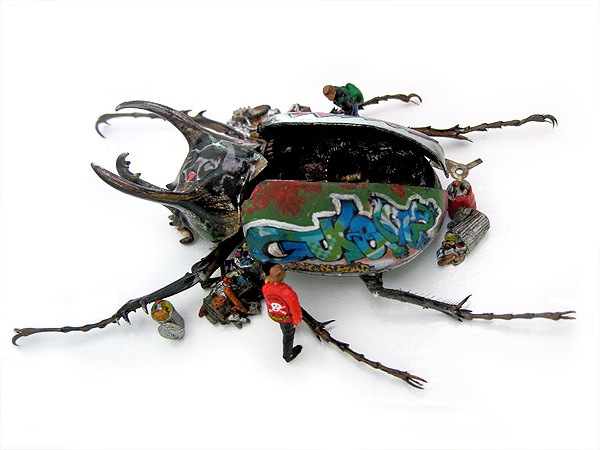
Sometimes, you see something that takes you back to your childhood, whilst simultaneously propelling you into the future, or, even, an alternate-dimensional playground that you wish you could immerse yourself in. Scott Bains insectile creations, and our alternate counterparts, exist in very a different world to you and I. It is a “living” world, one that feels subtly familiar – albeit with vastly different possibilities.
He describes this world, much better than we would, by “ …examining what makes the insect world tick, and considers our attempts to control nature and the consequences. Humanity’s blatant disregard for nature, where profit comes before life, will ultimately be our undoing. Pesticides, herbicides, genetic modification and massive urban expansion push the fine balance of life toward disaster. There has to be a point, when mother nature will say ‘too far’, and rid the earth of its biggest pest… us.
Once the stuff of science fiction, today flying and crawling insects are used by the military, fitted with audio and video devices.
This exhibition experiments using real taxidermy beetles as mechanised shells, to show how we mistreat our fellow inhabitants, forcing them to do our will – when the planet’s soul is gone, all that’s left is cogs and pipes. You won’t see insects like these on the Discovery Channel.”
For ages after seeing this work, we’re still trying to wrap our heads around its many meanings, interpretations, nuances and themes – the only thing we really knew, after having discovered Scotts work, is that his Micromachina project, and the artist himself, was something that we just had to feature – because it is, quite simply, awesome …
You have a background in design, which obviously plays a big part in the development of these sculptural pieces of yours – but can you tell us a bit more about that background, and what else you do when you’re not diving into the bits of insects?
Yeah, the design background comes in very handy when planning out each piece. I have a clear vision in mind before I start cutting. I’ve been experimenting with various art forms for years, but have been waiting for this ‘new’ idea before exhibiting.
Art gives me 100% freedom to create.

Okay – where did you get the idea for Micromachina? 1950s nuclear scare movies? Starship Troopers? Fallout? Booze? … really, what’s with the bugs?
Actually, I have always had a dark fascination with dead stuff and dusty Victorian taxidermy. Cabinets of curiosities are my main influence, antique collections of bizarre artefacts, rarely seen. I have taken this concept and brought it into modern scenarios.

Our first thought when we saw your sculptures was … “what the hell?” – is that a usual reaction to your work and is it usually followed by something like our second reaction, “oh man, that’s so damn cool?” – what do you think the general publics thoughts are on this body of work?
That’s the best reaction! When people think they are toys or plastic, then realize they are real taxidermy pieces. Lots of people are freaked out by creepy crawlies. This takes it a step further (creepy creepy crawlies). It has been amazing to see how far the exhibition images have travelled around the world and the comments in all languages, on the artworks and Nature Vs Humanity.

How do you deal with the fact that you are working on such a small scale? Is it an impedance, or do you believe that by working in miniature, you are able to do certain things you wouldn’t if they were scaled up?
The small scale is a great way to create massive sculpture scenarios in your studio. Scaling it all down, I’m able to make whatever I want. But then again… anyone got some massive steel sheets and rivets?

Without revealing too many secrets, tell us a little about the techniques you’re using here – where you find your bits and pieces, and how you learnt this art of micro sculpture?
That’s one of the hardest parts, locating the pieces to fit each concept. I come up with the idea first, then go on missions sourcing the parts I need.
I did a bit of model building as a kid, and recently re-discovered and re-invented the techniques to suit artworks. The parts are minute, and there’s a lot of swearing that goes into each piece.

How do you think up the various scenarios that your insects and “people” are involved in? Where does that form of inspiration come from?
The Micromachina exhibition is based around the commentary of how people abuse and destroy nature for profit, and how ultimately mother nature will take over and shake off the human species. I use each insect to illustrate the relationship between humans and the natural world – and no, I didn’t kill the insects, they died of old age … and donated their bodies to science …

We opened this article with the image of a beetle that had been covered with a nice looking piece of graff – what’s your affinity with street or urban art, if any? Or was it more a play on archetypes – ie, have beetle, will bomb?
Street art is one of the few art forms that can make social comment, and engage the viewer to question the world around them. It takes back ‘public’ space from corporations and greedy developers who want to sterilize cities.
Urban Camouflage is a metaphor for how city buildings are left abandoned and slowly decay … how quickly nature will take over these spaces when we are gone.

What’s next in the world of Micromachina? We hear you’re already working on another set? Can you tell us a bit more about your future direction with this work?
It’s still a secret work in progress … under very small wraps … Watch this space – www.micromachina.com coming soon …
Check out Scott Bains profile on Behance. Micromachina is on in conjunction with the Adelaide Fringe Festival until 13 March 2011, and there are still a couple of works for sale – so get to the Tin Cat Cafe, 107 Rundle Street, Kent Town, Adelaide to see it for yourself.
On a editors note – every so often you see stuff that is so fkn cool that you just have to tell other people about it – that’s how I felt when I saw Scott Bains work earlier this week. Man, that happens a lot. I consume blogs like a stoner consumes old Jamaica chocolate, and I see a lot of art online, week in, week out. I try hard to adhere to our “urban/street/underground” theme, but often, this is really difficult – there are so many different permutations and derivations of awesome work from those three words – but the main attempt is to cover stuff that “revolves” around them. I probably sometime leave stuff off that should be on here, and put stuff on here that probably shouldn’t – all in all though, I hope I hit the mark. Then, every so often, you see something that simultaneously has no association looks at those three themes in an entirely new aspect, and you know you just cant pass it up. Is it urban? Is it street? Is it underground? Who knows? Who fucking cares? But I love it, and I hope you enjoyed finding out more about his work as much as I did … F.


Leave a Comment
Your email address will not be published. Required fields are marked with *